
This report has been updated to reflect a post-publication comment provided to Important Context by Liam Neeson’s publicist.
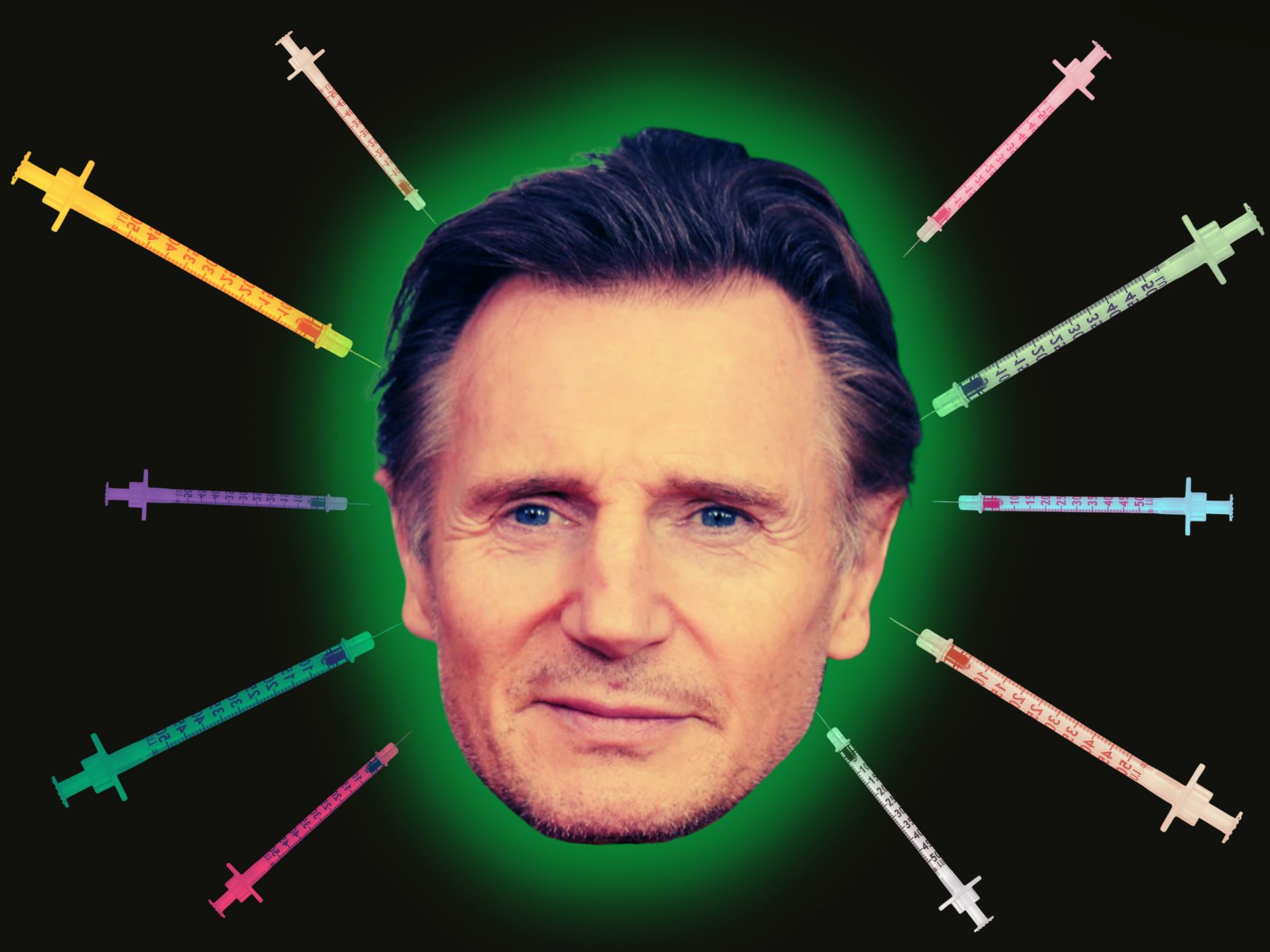
Liam Neeson has a very particular set of skills—skills he recently lent to a new anti-vax documentary that glorifies the rise of Health and Human Services Secretary Robert Kennedy Jr.
The Academy Award-nominated actor, known for leading roles in Schindler’s List and the Taken franchise, narrated the film, which includes interviews with Kennedy and other prominent anti-vaccine activists.
Plague of Corruption: 80 Years of Pharmaceutical Corruption Exposed features a bevy of discredited claims about vaccines, including that they cause autism and aluminum toxicity, and frames Kennedy’s leadership of U.S. health policy as hopeful.
The film is based on a book co-authored by disgraced researcher Dr. Judy Mikovits—known for her role in the Plandemic series—and attorney Kent Heckenlively. The book was published by Children’s Health Defense, the multimillion‑dollar anti-vax group founded by Kennedy.
Neeson’s involvement comes at a pivotal moment as Kennedy’s HHS dismantles U.S. public-health infrastructure, including the childhood immunization schedule, as vaccine-preventable diseases reemerge.
For the A-lister, who has been a Goodwill Ambassador for UNICEF since 2011 and assisting with global vaccine efforts, this is a U-turn.
In 2022, Neeson said vaccines were “a remarkable human success story” and recorded a video thanking scientists, including Hungarian biologist Katalin Karikó, who was instrumental in the development of mRNA COVID vaccines. In Plague, Neeson calls those vaccines “dangerous experiments,” and frames the mainstream scientific community as “fanatics” and “defenders of…orthodoxy” who “demand unconditional submission.”
“Liam Neeson should not lend his name to promoting an anti-science, anti-public health documentary,” said professor Dorit Reiss, a vaccine law expert at the University of California San Francisco College of the Law. Reiss noted that children have already died this year as a result of preventable outbreaks fueled by policies under Kennedy and Trump.
Teal Cannaday, a publicist for Neeson, declined to comment by the time of publication. UNICEF did not respond to our inquiry.
“Consciousness-infused storytelling”
Plague is the first project of Amigo Film Studios. The nascent company’s website provides no information about the people or funding behind it.
Amigo’s CEO, Turu Sukhotin, is a producer on the film and self-described “multi dimensional healer” based in Los Angeles. According to her personal website, she offers “personalized transformation experiences that honor each person’s unique path back to authentic power” while Plague is “consciousness-infused storytelling that heals while it reveals.”
Director Michael Mazzola is better-known for his presence and work in the U.F.O. community. Last month, he and Heckenlively, who is an executive producer on the film, released a new book, “Catastrophic Disclosure: The Deep State, Aliens, and the Truth.” Several other members of Plague’s production team have worked on documentaries about paranormal phenomena.
Neeson is by far the biggest name attached to the production.
“All of the sudden, it wasn’t”
Plague opens by revisiting the events of Mikovits’ professional downfall. Neeson narrates that her 2009 paper in Science “rocked the scientific community” with its conclusion that “a deadly virus known as XMRV had infected millions of people and contaminated the global blood supply.”
”The source? Mouse tissue used in countless medical products for decades, starting most notably with the polio vaccine of the 1950s,” he says. “XMRV, reported as Chronic Fatigue Syndrome, was the biggest health crisis since HIV and AIDS, and then, all of the sudden, it wasn’t.”
The XMRV panic ended when Mikovits’ paper was retracted. Mikovits ultimately lost her job and was subsequently arrested after reportedly trying to steal notebooks from the lab where she worked.
The film paints the episode as a Big Pharma cover-up with Neeson suggesting two researchers who published papers debunking Mikovits’ paper were compromised by “pharma.” In reality, the 2009 paper’s results could not be replicated despite numerous studies attempting to do so, including an analysis by the original investigators.
“Dangerous experiments”
Near Plague’s end, Neeson veers into familiar pandemic talking points.
In a monologue he asserts that the SARS-CoV-2 virus came from a U.S.-funded lab in Wuhan, China. “The National Institutes of Health…avoided taking responsibility, bypassed oversight, and intentionally misled Congress, the American people, and the global community,” he says, adding that the agency “withheld crucial information about their activities and funding connections to gain-of-function research.”
Publicly available evidence points to natural spillover as COVID’s most likely origin—a conclusion reaffirmed in June by independent experts on a WHO panel investigating the matter.
Neeson also hits emergency COVID “lockdowns” implemented to halt the spread of the virus, which killed more than 1.2 million Americans. The measures have been a favorite target of GOP politicians as well as right-wing media, dark money groups, and business interests. He declares, “Thousands of lives were lost, not to the virus, but to the mental anguish brought on by these harsh restrictions.”
He then turns to COVID vaccines, estimated to have saved millions of American lives.
Preventable U.S. deaths resulting from vaccine-refusal number in the hundreds of thousands. Neeson, however, says, “these vaccines, rushed to market, were dangerous experiments.”
He continues, “...those responsible…continue to evade accountability.”
(Plague of Corruption clip used pursuant to fair use for news reporting.)
“A new chapter”
Plague is ultimately pro-Kennedy, presenting the anti-vaxxer as a truth-teller and letting him promote numerous falsehoods. The film ends with Kennedy’s appointment as HHS secretary, treating the moment as a national reckoning—using Neeson’s vocal timbre to great emotional effect.
“We cannot change the past, but we can demand transparency and accountability for the future,” the actor says. “We cannot bring back every loved one we lost, but we can honor their memory by seeking and upholding the truth.”
The film fades to black, returning on a dramatic straight-on shot of Kennedy sitting for his confirmation with reporters buzzing around him. To triumphant background music, Neeson wraps.
“This is not the end of our story,” he says. “This—is the beginning of a new chapter.”
—
UPDATE: After initially declining to comment, Cannaday provided the following statement to Important Context:
We all recognize that corruption can exist within the pharmaceutical industry, but that should never be conflated with opposition to vaccines. Liam never has been, and is not, anti-vaccination. His extensive work with UNICEF underscores his long-held support for global immunization and public-health initiatives. He did not shape the film’s editorial content, and any questions about its claims or messaging should be directed to the producers.
NOTE: Dr. Peter Daszak, who Plague suggests is implicated in funding the gain-of-function research at the Wuhan lab, sits on the board of directors of the Accountability Journalism Institute, which runs Important Context. He had no involvement in, influence on, or advanced knowledge of this article.