On November 3, Americans flooded the polls and delivered the Democrats sweeping, historic victories across the country. The Blue Wave, driven by predictable backlash to Donald Trump’s presidency, even washed over traditionally red states like Texas and South Carolina, delivering Democratic victories on economic populism and anti-corruption messaging.
In the face of the party’s new mandate, however, some Democratic centrists have been tamping down expectations.
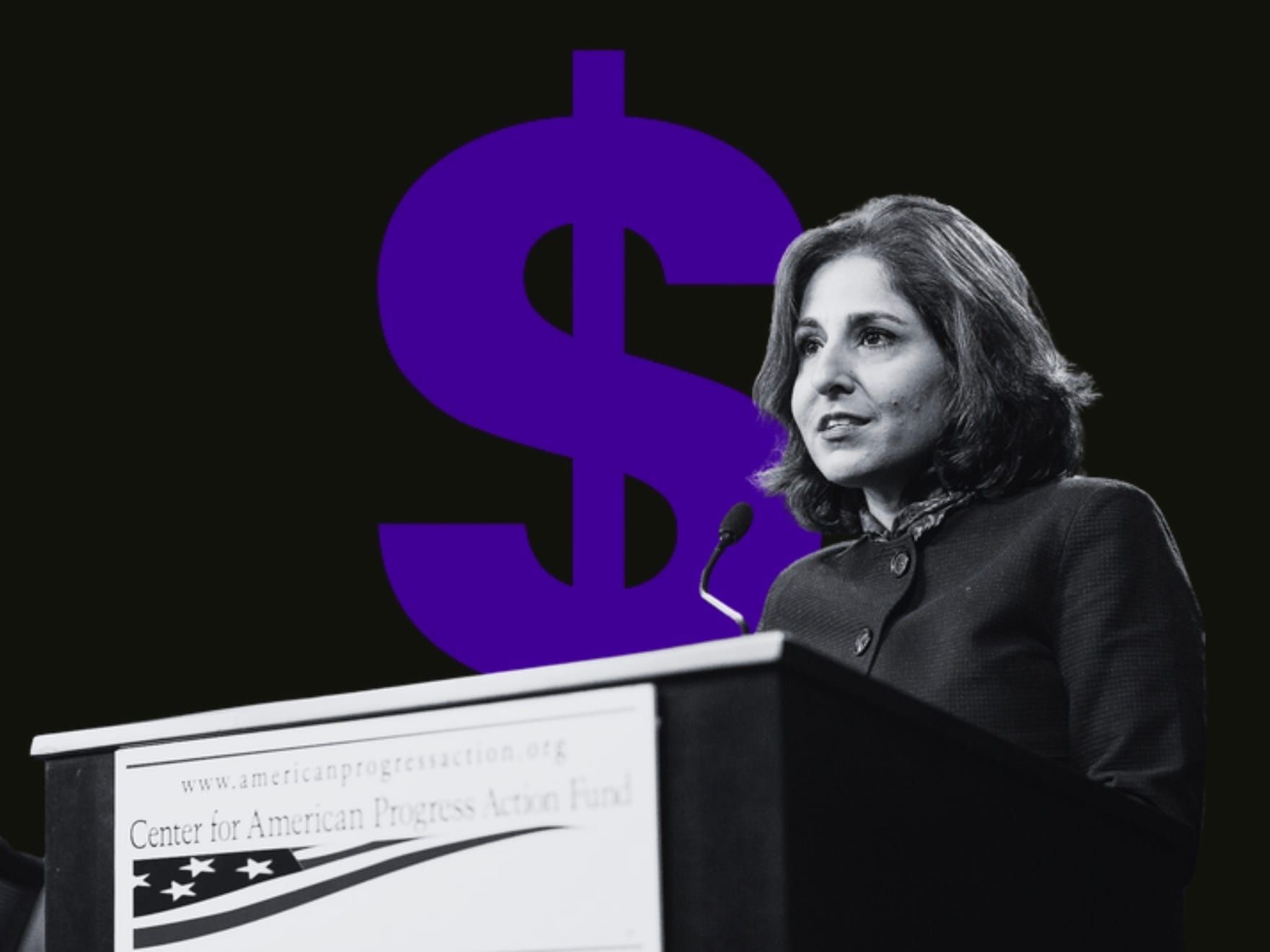
Within a week of the elections, Neera Tanden, president and CEO of the Center for American Progress (CAP), was addressing the National Press Club, cautioning against treating the moment as an opportunity for Washington organizations to “dust off” their longstanding policy demands.
“It’s not a time to pressure Congress to fruitlessly spend time, political capital on ideas that we couldn’t get done in a Democratic trifecta just a few years ago,” she said, arguing instead that Democrats should focus on delivering for the voters who elected them—whatever that meant.
"That's a message that unites," she added.
Underlying Tanden's appeal was a question about what interests will guide the Democratic Party’s agenda in the coming years.
For at least a decade, Tanden has been pushing back against progressive agenda items like Medicare for All, the proposal to establish a single-payer healthcare system in the U.S., which was central to Senator-elect Abdul El-Sayed’s high-profile winning campaign in Michigan. All the while, Tanden’s organization has been receiving millions of dollars from wealthy donors and corporations with clear stakes in those policy battles—and it is not alone.
An examination of federal tax filings and voluntary disclosures reveals that CAP and other influential centrist Democratic think tanks, including the Progressive Policy Institute (PPI) and Third Way, have received substantial funding from major corporations and billionaire-backed foundations that also bankroll conservative and free-market causes.
Founded by Democratic consultant John Podesta, the former chief of staff to President Clinton, during the George W. Bush administration, CAP has grown into a DC powerhouse, reporting more than $84 million in assets and $37 million in revenue on its 2024 990 form. Its affiliated advocacy arm, the Center for American Progress Action Fund, meanwhile, reported $13.8 million in assets and $22 million in revenue.
The group’s influence has made Tanden a key player in Democratic politics. She served as an advisor to Presidents Barack Obama and Joe Biden.
Alongside traditionally liberal funders, CAP's past donors include the health insurance industry lobbying group America's Health Insurance Plans (AHIP), the Blue Cross Blue Shield Association, and Blue Shield of California. Other disclosed supporters have included Citigroup, Blackstone, pharmaceutical giant Eli Lilly, and technology companies Apple, Facebook, Microsoft, and Google.
Billionaire-backed foundations whose policy interests sometimes align with those of conservative organizations have also poured money into Tanden’s operation. Between its 2021 and 2025 fiscal years, which run April 1 through March 31, the Peter G. Peterson Foundation gave CAP nearly $1 million, according to tax filings.
Peterson, a billionaire investment banker who co-founded Blackstone and served as Secretary of Commerce under Republican President Richard Nixon, was a leading advocate of austerity policies before his death in 2018. His foundation has continued promoting cuts to government spending while funding like-minded conservative and free-market organizations like the Manhattan Institute and the American Enterprise Institute.
In 2023, the foundation published an expert analysis arguing that the reimbursement reductions envisioned under single-payer proposals could limit Americans' access to healthcare and reduce the quality of care they receive. Like its leader, who helped shape the Affordable Care Act, CAP favors incremental, market-based healthcare reforms.
Another major CAP donor is hedge fund billionaire and former Enron executive John D. Arnold. Arnold's foundation, the Laura and John Arnold Foundation, which is now part of Arnold Ventures, gave CAP more than $1.5 million between 2020 and 2024.
Although Arnold has built a reputation as a Democratic donor, his giving has also supported conservative and free-market think tanks, including the Mercatus Center and the American Enterprise Institute. At the height of the pandemic, when business-aligned right-wing groups were pushing to reopen the nation’s schools, money from Arnold Ventures helped finance the COVID-19 School Data Hub. The hub, a project of Brown University economist Emily Oster—a vocal advocate of school reopening—also received money from Emergent Ventures, a grantmaking initiative at Mercatus.
One area where Arnold's philanthropic interests intersect with CAP's policy work is education. Arnold has been a major backer of the charter-school movement, which seeks to transform American education by expanding privately managed alternatives to traditional public schools. His foundation has given millions of dollars to the Charter School Growth Fund, including a whopping $6 million between 2020 and 2022 alone.
Other prominent advocates of charter schools have also given substantial sums to CAP. The Bill and Melinda Gates Foundation gave more than $8.2 million between 2017 and 2024, while the Walton Family Foundation, established by the family behind Walmart, contributed $1.2 million between 2020 and 2023.
CAP itself has advocated for charter schools. On its website, the organization says it supports "public school choice,” noting, “We argue that there is a progressive case for charters focused on growing and learning from successful models, while also addressing gaps in charter policy, such as the problems with for-profit, virtual charter schools.”
CAP is not the only Democratic centrist organization receiving significant support from conservative financial interests.
PPI, another influential Democratic-aligned think tank associated with the party's centrist wing, has received funding from major corporate interests, including Exxon Mobil.
PPI operates the charitable Third Way Foundation and shares a board member, William Budinger, with the group Third Way, another fixture of the centrist ecosystem—though the two are legally distinct entities. Third Way has received funding from the Business Roundtable, Verizon, and a health insurance industry group tied to Republican consultants. The group is opposed to Medicare-for-all and launched a $15 million, multi-year campaign targeting the Democratic Socialists of America after El-Sayed’s primary win this year.
Like CAP, PPI and Third Way have also embraced school choice to some degree. Robin Lake, a board member of PPI’s foundation, is the director of the pro-charter Center on Reinventing Public Education at Arizona State University’s Mary Lou Fulton College for Teaching and Learning Innovation.
In a recent report, Third Way argued that Democrats should recognize growing demand for educational options and concentrate on improving how school choice works, rather than rejecting it outright.
"While polls are inconsistent on how to implement school choice, there is no denying that Democrats must respond to parents who increasingly express a desire for options in where and how their children learn," the report stated.
In addition to overlapping policy stances, Third Way shares some of the same funders as CAP. The Peter G. Peterson Foundation contributed nearly $300,000 to the Third Way Institute in FY 2025.
Arnold's foundation gave $175,000 to the Third Way Foundation and approximately $531,000 to the Third Way Institute in 2024. The Third Way Foundation also accepted roughly $1.7 million from the Walton Family Foundation between 2020 and 2024, with much of the funds going toward PPI's education work, including its "Reinventing America's Schools" program. The Third Way Institute has received more than $10.6 million from the Gates Foundation since 2017.
Funding from a donor does not, by itself, establish influence over an organization. But the big money flowing into centrist think tanks offers insight into the competing interests shaping the Democratic Party's future as it prepares to retake control of Congress in January.
The day after her National Press Club address, The Bulwark, the neoconservative, never-Trump publication, released a podcast episode with Tanden. During the interview, the CAP leader declared, “This is an election for normie Dems,” highlighting a handful of races where candidates talked about “extremes on both ends.”
“Everyone’s going to relitigate what election happened where and what and dadada, but the truth of the election for everyone to see is this was the revenge of the normies,” she added.
Billionaire John Arnold appeared in the same podcast episode.