This piece was produced in partnership with Assigned Media.
In the week after elections, the tally seemed bleak for queer Americans: A series of losses on ballot questions, tempered only perhaps by candidates breaking through to win state and local office.
The Election Day? Nov. 2, 2004.
“In 2004, there were 13 ballot measures across the country trying to restrict marriage equality, and we lost every single one of them and we lost them by an average of 41 points,” said Logan S. Casey, director of policy research for the progressive think tank Movement Advancement Project.
By comparison, the results last week on trans-related measures were far from unanimous and not nearly so resounding:
- Washington State rejected a “parental rights” measure intended to out kids questioning their sexual orientation or gender even as state voters adopted an anti-trans sports ban;
- Vermont voters decisively backed the extension of constitutional protections to include gender;
- Missourians rejected by a double-digit margin a Republican-led effort to ban abortion by coupling it with an unrelated transphobic measure.
In Colorado, a blue state known for protecting the rights of trans people, the disappointing passage of care and sports restrictions initiated by right-wing groups was mitigated by the narrow margin of victory and the immediate skepticism from Democrats about its enforceability and compliance with existing anti-discrimination laws.
“We lost two ballot measures in Colorado, but we lost them by four points,” said Casey, who is trans. “Just that magnitude of difference is really remarkable and speaks to how well our movement continues to do this hard work of changing hearts and minds. Yes, we lost, and we should grieve that, and I feel that pain too. But four points is really different than 41 points.”
And at a press conference, the incoming Democratic governor of Colorado, Phil Weiser, cast a critical eye on the measures. “It’s important that we recognize that sometimes, something is passed and it is incomplete. It is not administrable.” He added: “We’re going to have to take a look at these anti-trans measures and what adjustments are necessary and appropriate.”
Democrats are raising similar questions in the blue state of Washington, where the sports ban initiative calls for invasive sex-verification exams of all girls K-12. “We believe this initiative is unconstitutional on its face and support organizations planning to challenge it in court,” the party said in a statement issued soon after the vote. “It undoes protections in Washington state law passed 20 years ago.”
The measure is due to take effect Dec. 3. Ballot initiatives approved by voters in Washington State cannot be repealed or revised immediately by the legislature without two-thirds support in each chamber, so a court challenge is seen as the likeliest avenue to block it from going forward.
A coalition of legal and advocacy groups is planning to mount such a challenge, based at least in part on claims it would violate existing state privacy protections.
Transphobic Ads Failed
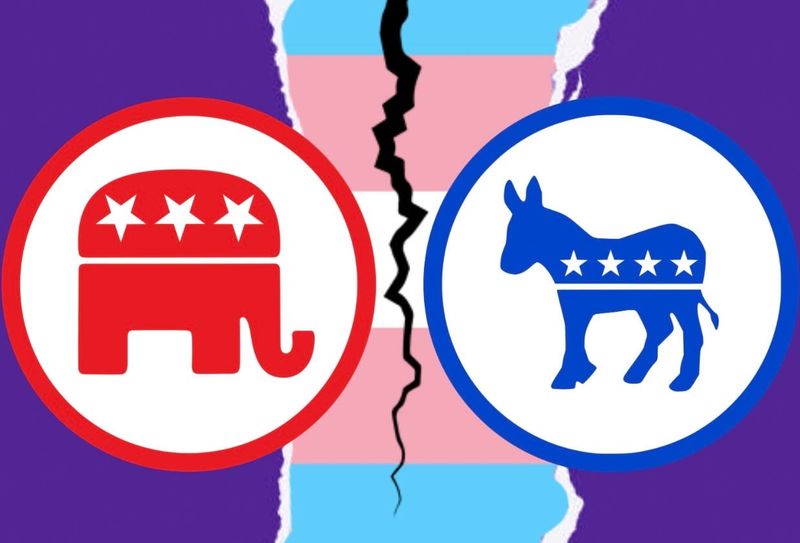
The Republicans’ intense strategic focus on transphobic attack ads was shown to be ineffectual this year, with even Florida Gov. Ron DeSantis calling them “yesterday’s battles.”
“Republicans spent millions on anti-trans attacks, and they fell flat,” said Tyler Hack, the founder and executive director of the Christopher Street Project, which works to elect candidates who will defend trans people. “It is pretty clear that trans issues are not what the American people are focused on. They’ve woken up to the fact that trans people are not the reason they can't afford gas or groceries.”
More than $180 million was devoted to transphobic attack ads nationwide, according to GLAAD and other reports, with Texas alone targeted with $78 million in anti-trans ad spending. But Republicans lost the Texas senatorial and gubernatorial races along with every other statewide office, and surrendered control of the state House of Representatives. All in all, it was the party's biggest defeat in decades.
Nationwide, trans and nonbinary candidates made historic electoral gains last week. Six won legislative seats in states that have never elected a trans person to their assemblies before, including Allison Montgomery in Alabama and Jaelynn Scott in Washington State, the 19th reported. Quinnie Perez, who won a seat on a local soil and water conservation board, became the first trans candidate ever elected in Florida.
“Having trans people elected to office is really important for a number of reasons. There's just the basic principle of having a government that looks like the people it's supposed to represent,” said Casey, the policy analyst, noting that it also serves as an example for other trans people, especially young people, to consider public service.
The presence of trans and nonbinary people in state legislatures and other governing bodies transcends actual lawmaking, he said. “It’s the human connection with their fellow legislators.”
“It may be the case that a trans legislator never writes a bill that is explicitly about trans people, but just by virtue of being in that legislature they can have a really positive impact: They may be the first trans person those other elected officials have ever met, let alone talk to or work with.”
“That itself can have an effect on the types of bills and the dynamics within those legislatures and governing bodies.”
Surveys published this year and last by the Human Rights Campaign and the Pew Research Center found that well under half of Americans report personally knowing a trans person.
“And so, the information that they are operating on is frequently either a lack of information or misinformation that has been intentionally constructed to be as scary and as dehumanizing as possible,” Casey said.
Thus, he added, “numbers and statistics are not always persuasive on their own. You have to really meet people where they are. It's that old thing of you can't bring facts to a feelings fight.”
Building a Pro-Trans Majority
In Missouri, the statewide LGBTQ+ policy and advocacy organization PROMO sees this as a long-term effort that entails personal conversations with voters, a tactic known as “deep canvassing.” PROMO was part of a coalition that successfully campaigned against the state’s Amendment 3, which tried to leverage transphobia to ban abortion.
“Our goal is to build a pro-trans majority in Missouri, which means that the majority of voters in Missouri would reject any candidate, law, or ballot initiative that tries to discriminate against trans Missourians,” PROMO’s communications director, Robert Fischer, said. “We understand that this would be a 5-10 year goal, which is why our deep canvassing work is about power building. We set out to have 10,000 completed conversations with voters across the state and we are proud to say that we exceeded that number, hitting over 13,000 by Election Day.
“We've seen the beginnings of people's hearts and minds shift in Missouri as we talk to voters. There are so many people in each of our regions that simply are eager to talk with a trans person — to hear more from them and learn more about them. Our deep canvassing program started in 2024 and it will continue after this year's election.”
“Nationally,” Fischer added, “I think you'll see Missouri is on pace with the rest of the country in that voters are tired of politicians using trans people as political fodder.”
Health care for trans Missourians under 18 was already banned by law when Republicans put Amendment 3 before voters, packaging it with new, blanket restrictions on abortion.
The result? “It failed by 11 percentage points. It wasn't close,” said Kenneth Warren, professor emeritus of political science at St. Louis University and associate director of the SLU/YouGov poll. Abortion rights enshrined by voters just two years ago in a ballot initiative had passed by a much narrower, three-point margin.
“Once voters got to know it was put on the ballot just to trick them, I think that there was a backlash,” Warren said. “I don't think that tactic will be used again elsewhere because people will see how it backfired in Missouri.”
The existing prohibition on trans youth care has a sunset clause of August 2027, meaning the legislature will have to extend the law or see it expire. Though Republicans in Missouri lost their legislative supermajority, Warren said he didn’t believe Democrats, themselves conservative, would muster an effort to have the law expire.
He did point to one notable shift at Missouri’s U.S. Congressional level: The election of Fred Wellman, a liberal podcaster who faced attacks from the Republican incumbent Ann Wagner for his support of trans people.
“People like me have to stand up,” Wellman said in a May interview with OutInSTL. “Because I’ve never had to fight just to exist. And a lot of people in this community still do.”
“Ann Wagner went after him on that,” Warren said, “and it didn't connect. Wellman won by 5 percentage points.”